
How Insurance, Flood Maps and HOA Reserves Change the 10‑Year Cost of a St. Petersburg Condo
11/02/26
If you’re eyeing a condo in downtown St. Pete, Snell Isle or Historic Old Northeast, the price on the listing is only the first number. Here’s how 2026 insurance dynamics, flood maps and Florida’s new reserve rules shape the real 10‑year cost—and how I underwrite it for you.
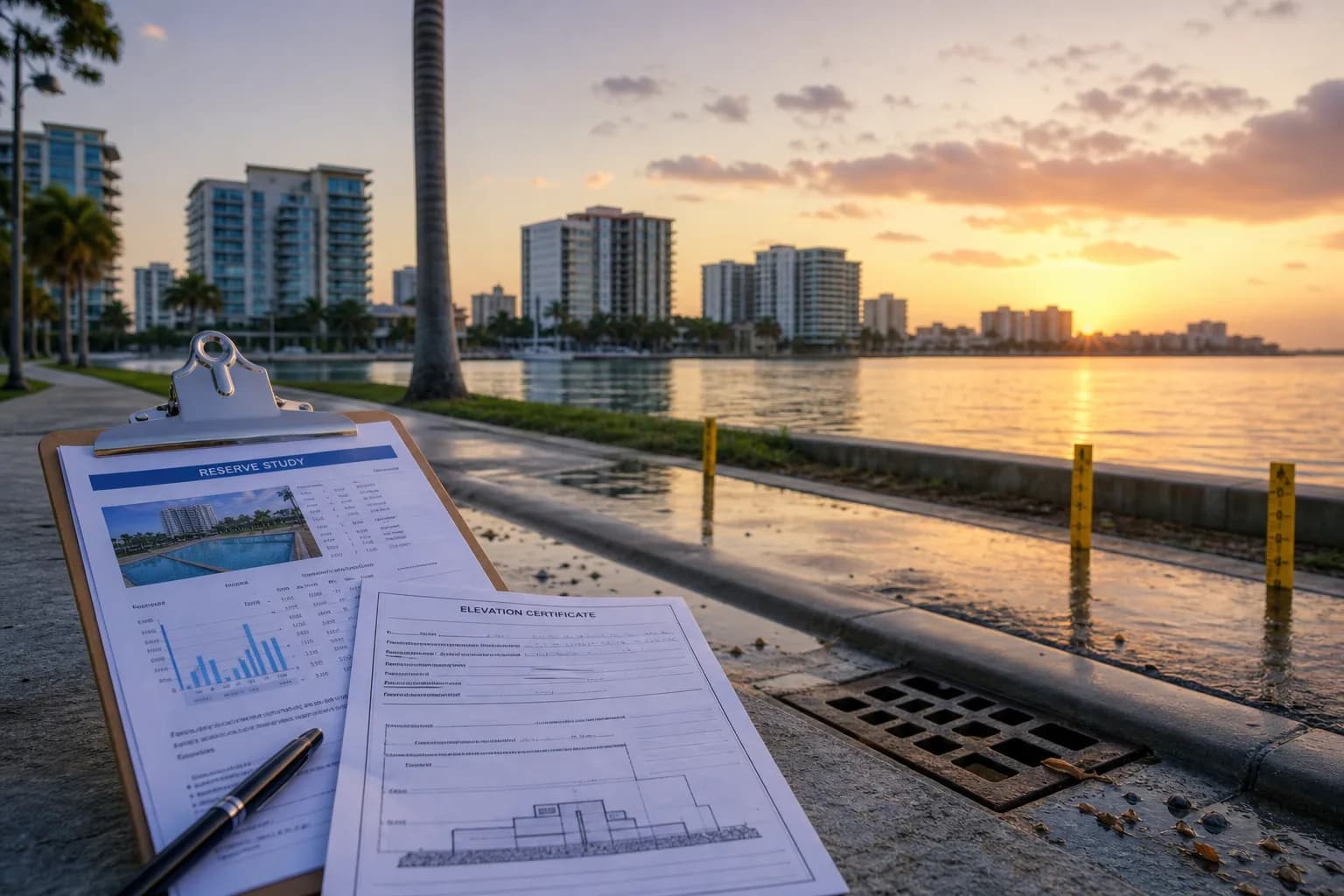
If you’re shopping condos in downtown St. Petersburg (33701), Snell Isle or Historic Old Northeast (33704), the number on the listing is just the first number. The real question is: what will it cost to own—comfortably—for the next ten years? That answer lives in three places: your association’s insurance, your building’s flood profile, and the reserves plan the board is now required to fund.
I’m Jon Kelly. Before real estate I spent 25 years underwriting complex capital stacks. Today I bring that same discipline to your condo search—the association’s books, the structural record, the numbers behind the number.
Why 2026 is a turning point
- State rules and deadlines: After Surfside, Florida required milestone inspections and Structural Integrity Reserve Studies (SIRS). Associations must have a SIRS completed by December 31, 2025 and begin funding in line with that study on January 1, 2026. Milestone inspections for applicable buildings are due by December 31, 2026, with limited local extensions available when a contract is in place and timing is infeasible. These dates drive dues and special assessments in the next budget years. (condos.myfloridalicense.com)
- Insurance market: Citizens Property Insurance—Florida’s insurer of last resort—has OIR‑approved statewide personal‑lines rate decreases taking effect on or after June 1, 2026. But depopulation rules still push many owners to private carriers if a comparable offer comes in within 20% of a Citizens renewal premium. Commercial‑residential (association master) policies are improving unevenly; the state’s largest condo-association carrier has reported softer pricing and lower gross premiums written through 1H 2026. Translation: relief for some buildings, not all. (floir.gov)
- Flood risk and maps: Flood insurance requirements are based on FEMA’s Flood Insurance Rate Maps (FIRMs). Pinellas County maintains a public map portal and reminds owners that federal requirements hinge on FIRMs, not local overlays. Separate FEMA map updates are underway for the Alligator Creek watershed elsewhere in the county—check your specific address rather than assuming neighborhood‑wide changes. (pinellas.gov)
- Local discount you should know about: The City of St. Petersburg participates in FEMA’s Community Rating System (CRS) at Class 5, which translates to up to a 25% discount on NFIP premiums citywide—your actual policy still depends on your building’s elevation and flood zone. (cms5.revize.com)
Neighborhood snapshot: how risk and rules show up on your bottom line
-
Downtown St. Petersburg (33701)
- What’s here: A mix of 1970s–1990s towers like Bayfront Tower and newer high‑rises on Beach/Bayshore corridors. Many addresses sit in FEMA Zone AE along the waterfront; a few blocks inland often shift outside the Special Flood Hazard Area (Zone X). Inspection and SIRS requirements vary by building age and height, so two adjacent towers can have very different reserve/insurance trajectories. (stpetehomeguide.com)
- Market read: Florida Realtors’ September 2026 release shows statewide condo‑townhouse sales roughly flat year‑over‑year, with third‑quarter condo activity improving—a reminder that pricing and absorption are shifting by product and location. Use building‑specific comps rather than metrowide averages. (floridarealtors.org)
-
Historic Old Northeast (33704, west of the bayfront)
- What’s here: Early‑ to mid‑20th‑century structures and small condo conversions. Eastern edges near Tampa Bay and Coffee Pot Bayou include AE pockets that see tidal flooding in heavy‑tide/rain events; inland blocks often shift to Zone X. Expect SIRS impacts where buildings reach the inspection window. (stpete.org)
-
Snell Isle (33704, peninsula east/northeast of Old Northeast)
- What’s here: A low‑elevation bayfront peninsula with widespread AE zoning; several condo buildings front open water and channels. Flood elevation and the building’s elevation certificate drive premiums more than the unit itself. Association master policy pricing will reflect waterfront exposure and any recent claims. (pinellas.gov)
Quick explainer: why these three levers matter
- Association insurance (master policy) typically covers the building shell, common elements and liability; for waterfront or older structures it is one of the largest budget lines. Florida’s property‑insurance reforms and improving reinsurance conditions have lowered rates for some, but not all, association programs in 2026. I do not assume your building followed the average—I read the actual dec page, deductibles and prior‑year premium. (floir.gov)
- Flood risk adds two costs: the association’s flood policy (if required for the building’s zone) and your unit’s optional or required coverage. Because St. Petersburg is a CRS Class 5 city, many NFIP policies get a discount, but premiums still hinge on the Elevation Certificate and the structure’s relation to Base Flood Elevation (BFE). (cms5.revize.com)
- Reserves are now on a timeline: a SIRS by 12/31/2025, with funding beginning 1/1/2026. Reserve contributions will move dues; underfunded buildings may add special assessments to catch up capital projects the study identifies. (condos.myfloridalicense.com)
Three 10‑year cost pictures (illustrative math you can adapt to any building)
Assume: a 1,200 sf, 2‑bed condo; current monthly dues $750; of that, $250 represents the current year’s share of the master insurance and flood line items. These are not market averages—they’re placeholders you can swap with your building’s actual numbers.
-
Conservative (if the building is well‑funded and well‑insured)
- Assumptions: master insurance/flood net change +2%/yr; reserve dues +3%/yr; no special assessments.
- 10‑yr total carrying cost due to dues: Year‑1 $750 → Year‑10 about $980; cumulative ~ $104,000 over 10 years.
-
Realistic (what I’m penciling most often in 2026)
- Assumptions: master insurance/flood +4%/yr through 2028, then +2%/yr; reserves +5%/yr as SIRS funding ramps; one special assessment of $12,000 in Year‑3 for exterior/coatings, amortized over 5 years at 0% (board payment plan).
- 10‑yr effect: dues trajectory Year‑1 $750 → Year‑10 about $1,050; plus $200/mo equivalent for 60 months (the assessment) = $12,000. Cumulative ~ $118,000 in dues + $12,000 assessment = ~$130,000.
-
Stress case (what I underwrite so you’re not surprised)
- Assumptions: master insurance/flood +8%/yr for 3 years, then +3%/yr; reserves +8%/yr for 4 years; one major special assessment of $35,000 in Year‑2 for structural/elevator, amortized over 7 years at 0%.
- 10‑yr effect: dues Year‑1 $750 → Year‑10 about $1,250; plus $417/mo equivalent for 84 months (the assessment) ≈ $35,000. Cumulative ~ $140,000 in dues + $35,000 assessment = ~$175,000.
Tip: Replace the assumptions with the building’s real numbers from the current budget, insurance renewals and SIRS cash‑flow schedule. If the association’s insurer is Citizens (for a master wind‑only layer) or your personal policy is with Citizens, remember that OIR approved 2026 decreases for certain Citizens personal‑lines programs, and the “20% rule” can change your eligibility at renewal if a private‑market quote comes in close. (floir.gov)
What I look for in a condo’s books (a resilience checklist)
- Reserves
- Fresh SIRS on file (or underway) and reserve contributions aligned with it for fiscal 2026.
- Percent funded: many reserve professionals view 70%+ as “strong,” ~30–70% “fair,” and below ~30% a higher‑risk zone for surprise assessments. I don’t require a single number, but I want to see a plan to move into a healthy range. (reservestudy.com)
- Update cadence: site‑visit reserve study at least every three years is common best practice. (reservestudy.com)
- Insurance
- Who is the carrier panel? What are the named‑storm/wind deductibles? Any changes YOY on coverage, limits or exclusions? If Citizens is in the mix, I confirm whether any depopulation/takeout activity affects eligibility at renewal under the 20% rule. (citizensfla.com)
- Flood profile
- FEMA flood zone and Base Flood Elevation for the parcel; current Elevation Certificate on file; any recent flood claims (association and unit‑level, if available). Pinellas County’s Elevation Certificate resource and FEMA definitions make this fast to verify. (pinellas.gov)
- Capital projects
- Minutes and budgets for concrete restoration, waterproofing/paint cycles, roofs, elevators, fire life‑safety and façade work the SIRS identifies. Timing + scope = whether a special assessment is likely in your hold period.
- Governance and compliance
- Evidence that the board understands SIRS funding requirements for 2026 and has submitted the required SIRS reporting to the state when completed. (condos.myfloridalicense.com)
Sidebar: how neighborhood traits translate to line items
- Waterfront AE zones (Beach/Bayshore corridors, Snell Isle edges): higher wind/flood exposure drives master‑policy pricing and may require separate flood limits; your personal HO‑6 and flood can also tick up. Elevation above BFE is a key lever. (pinellas.gov)
- Coffee Pot Bayou/Old Northeast AE pockets: nuisance/tidal flooding history along some low‑lying edges means I scrub Elevation Certificates and prior flood determinations closely. (stpete.org)
- Inland Zone X pockets (parts of Edge District/Grand Central and west of 4th St.): often lower or optional flood premiums; I still review drainage/stormwater reports and any historical water intrusion noted in minutes.
Where I pull the numbers (so you can too)
- Insurance and depopulation rules: Florida Office of Insurance Regulation orders and Citizens policy guidance; 2026 Citizens rate changes are effective for renewals on or after June 1, 2026, and the 20% eligibility rule governs many renewal decisions. (floir.gov)
- State condo deadlines and reporting: DBPR’s condominium resources pages clarify SIRS and milestone inspection deadlines, funding start in 2026, and post‑SIRS reporting requirements. (condos.myfloridalicense.com)
- Flood and elevation: Pinellas County’s flood maps and Elevation Certificate portal; FEMA FIRMs determine federal insurance requirements; the county also notes map updates underway for parts of the county outside St. Pete. (pinellas.gov)
- Market context: Florida Realtors’ September/3Q 2026 releases show statewide condo‑townhouse sales stabilizing; use these for context, but make your valuation with building‑level comps and the association’s actual financials. (floridarealtors.org)
- Association‑policy backdrop: Florida’s leading condo‑association carrier reported softer pricing and lower premiums written through the first half of 2026—evidence that some buildings will see relief, though outcomes vary by loss history, construction and proximity to open water. (sec.gov)
Next steps if you’re considering a St. Pete condo
- Send me the HOA packet: current budget, year‑over‑year insurance invoices/dec pages (master and flood), the most recent reserve study/SIRS, last 12 months of minutes, planned projects, and the Elevation Certificate.
- I’ll build your 10‑year carry: dues path, plausible special‑assessment scenarios, and insurance/flood ranges for that specific building—not a citywide average.
- Want to double‑check a building or address? You can also look up parcel‑level history and documents at the Pinellas County Property Appraiser site. (pcpao.gov)
If you have a condo in mind, send me the HOA packet and I’ll walk through the numbers with you—line by line, risk by risk, so the home you love is a home you can comfortably own.