The True 10‑Year Cost of Owning a St. Petersburg Condo
09/28/26
Sticker price is only the start. I walk you through how I underwrite the next 10 years of costs for a St. Petersburg condo—reserves, flood, insurance, taxes—so you can buy with eyes open.
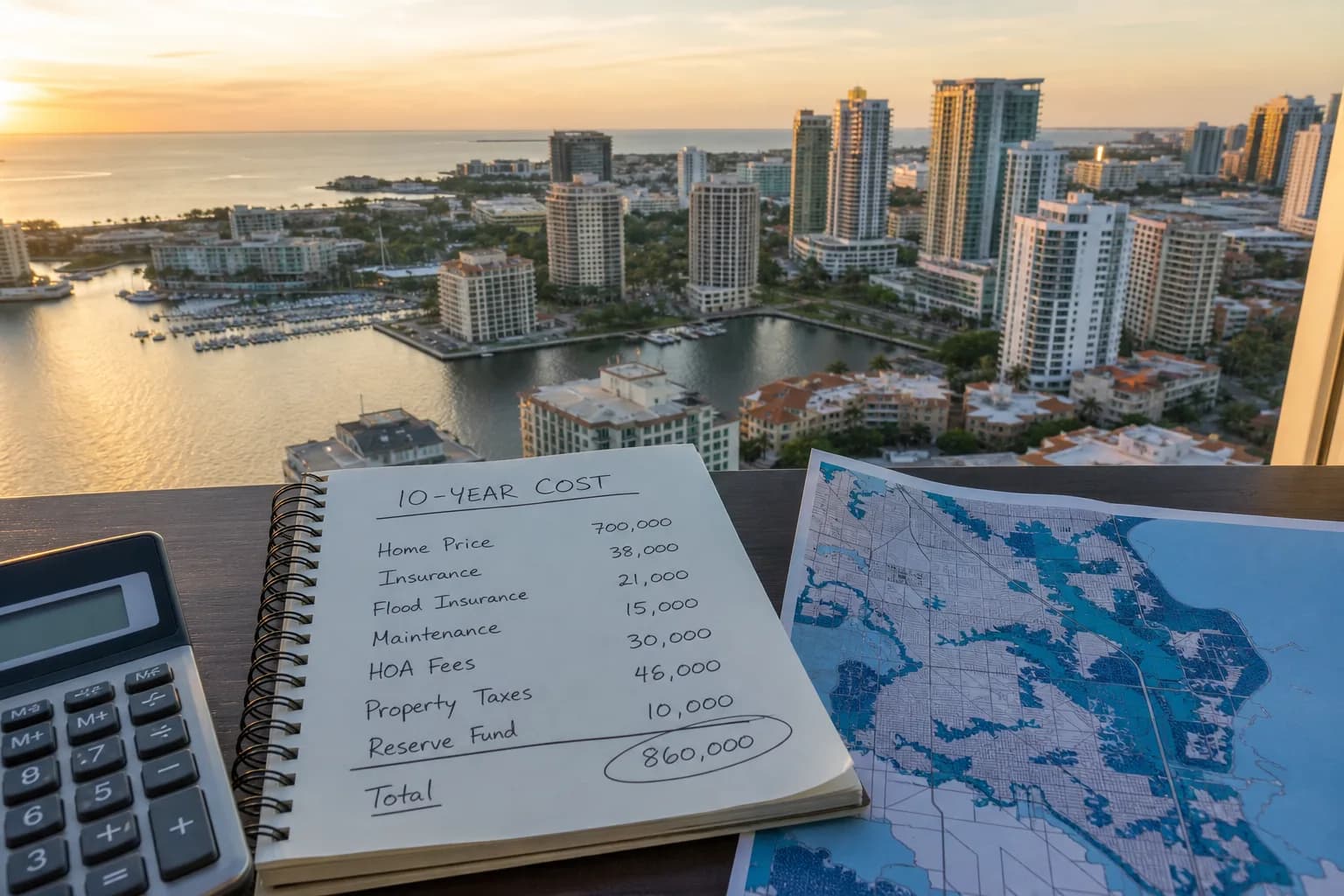
I’ve spent most of my career underwriting complex financings where a missed detail was never small. That same discipline guides how I help you buy a condo in St. Petersburg. The list price and this year’s HOA fee are just the starting line. The real question is: what will it cost to own—responsibly—for the next 10 years?
Below is the framework I use with every buyer. It’s plain‑English on purpose, with steps you can follow and a simple worksheet you can copy.
1) Why the sticker price is only the start
A condo is a share of a building’s future. Your share of tomorrow’s concrete restoration, roof, elevators, insurance deductibles, and flood losses will show up in your monthly dues, special assessments, premiums, and taxes. That’s why I underwrite the next decade before we make an offer.
For buildings three stories or higher in Florida, two state mandates now shape that decade: milestone structural inspections and Structural Integrity Reserve Studies (SIRS). Associations must complete a SIRS by December 31, 2025, and—once required—can’t waive or underfund reserves for the SIRS items in budgets adopted on or after December 31, 2024. Those items include roof, primary structure, fire protection, plumbing, electrical, waterproofing/exterior paint, windows and exterior doors, and other critical components. (condos.myfloridalicense.com)
2) Step 1: Check the HOA books
Ask for and read:
- The latest reserve study (SIRS if completed) and the current reserve balances.
- The budget and funding policy: straight‑line vs. pooled reserves; any “catch‑up” plan.
- The capital plan: what’s scheduled in the next 3, 5, and 10 years; vendor proposals; engineering reports.
- The most recent audited financials and any year‑to‑date variance report.
For buildings 3+ stories, confirm the association’s milestone inspection status and any required follow‑up work. State law sets the cadence: a milestone inspection when a building hits 30 years of age (25 years in some coastal jurisdictions by local schedule) and every 10 years thereafter; local building officials administer the program and publish deadlines. (flsenate.gov)
Pro tip: Florida’s condo statute requires associations to maintain official records and make them available to unit owners within defined time frames after a written request. Budget, financials, reserve schedules, inspection reports, and many contracts are part of those records. If you’re already an owner, use that right before you vote on budgets or assessments. (flsenate.gov)
3) Step 2: Hunt for special assessments and minutes
Special assessments don’t appear out of thin air. They’re usually foreshadowed in board packets, engineering memos, or project bids.
Where to look:
- Ask the manager for the last 12–24 months of board and membership meeting minutes, plus notices and agendas for upcoming projects.
- Search Pinellas County’s Official Records for your association’s name to spot recorded amendments, construction contracts, or liens related to unpaid assessments. It’s not exhaustive, but it’s a helpful cross‑check. (public.co.pinellas.fl.us)
- Review the city permit history for major work (roof, façade/concrete, windows, fire/life safety). St. Petersburg’s Click2Gov portal lets you look up permits by address. (stpe-egov.aspgov.com)
Also check new‑construction and developer sales disclosures for unsatisfied inspection/report obligations; state law now requires conspicuous statements in purchase contracts if a required milestone, turnover inspection report, or SIRS has not been completed. (leg.state.fl.us)
4) Step 3: Flood history and elevation (Snell Isle, Historic Old Northeast, downtown waterfront)
St. Petersburg is a waterfront city; risk varies block‑by‑block. Here’s how I quantify it:
- Look up the address on FEMA’s Flood Map Service Center to confirm zone (AE, VE, X, etc.), FIRM panel, and map revision date. Save the FIRMette PDF to your file. (dejavu.org)
- Pull or order an Elevation Certificate (EC). Pinellas County maintains an EC resource and can often point you to existing certificates; otherwise, a Florida‑licensed surveyor can produce one. ECs remain useful under private flood and NFIP Risk Rating 2.0 for pricing and mitigation decisions. (pinellas.gov)
- Check floodplain management benefits. The City of St. Petersburg participates in FEMA’s Community Rating System at Class 5, which generally provides a 25% premium discount for properties in Special Flood Hazard Areas. That’s real money over 10 years. (cms5.revize.com)
- Ask the association, in writing, for known flood and wind claim history and any mitigation work done (floodproofing, generator/electrical elevation, backflow valves). Pair what they provide with the permit log.
5) Step 4: Insurance reality (master policy + your HO‑6)
- Association master policies: Confirm property (including wind), general liability, and flood (if in SFHA or lender‑required). Note deductibles—especially hurricane/wind percentage deductibles—and who pays them if there’s a loss. Florida’s consumer guidance explains how hurricane deductibles work across a season. (myfloridacfo.com)
- Unit‑owner policies (HO‑6): Budget for coverage of interior build‑out and personal property, plus loss‑assessment coverage aligned to the association’s deductible.
- Citizens considerations: If the building or your unit ends up with Citizens for wind, Florida law phases in a flood‑insurance requirement for many personal residential policies with wind coverage, though condominium unit‑owner policies (HO‑6) are currently exempt from this statutory flood mandate. Always confirm your carrier’s rules. (flsenate.gov)
- Binding restrictions: Before and during tropical events, carriers routinely suspend binding new policies or coverage increases. Citizens posts binding suspensions publicly; Florida rules also require notice to the regulator when insurers temporarily stop writing. Plan your closing and insurance effective dates accordingly. (citizensfla.com)
6) Step 5: Taxes and operating costs
Forecast two tracks: ad valorem taxes and HOA/utility inflation.
- Property taxes reset for a new owner based on just value as of January 1 following your purchase. If you claim the Florida homestead exemption, future assessed value increases are capped at the lesser of 3% or CPI; non‑homestead properties are capped at 10%. Pinellas County explains the mechanics and mails TRIM notices each August. (pinellas.gov)
- Use the Pinellas County Property Appraiser’s Tax Estimator rather than last year’s bill to model your first‑year taxes and to test homestead portability scenarios. (pcpao.gov)
- If cash‑flow planning is key, Pinellas County also offers installment and partial‑payment options for property taxes under Florida law; deadlines and discounts are published by the Tax Collector each year. (floridarevenue.com)
For HOA dues, pull the last 5 years of fees to see the trend and compare to the reserve plan. If the SIRS shows large near‑term projects and reserves are thin, model a special assessment and/or step‑ups in dues.
7) Put it together: a simple 10‑year ownership worksheet
Below is a simplified example to show the math. These are hypothetical figures for illustration only—use the steps above to replace each line with your building’s actuals.
Sample 10‑Year Cost Table (Hypothetical Example)
| Category | Year 1 | Years 2–10 assumption | 10‑Year Total |
|---|---|---|---|
| Mortgage (principal/interest) | $0 shown here | Use your lender’s amortization | — |
| HOA dues | $900/mo | 3% annual increase | $123,933 |
| Special assessment (if any) | $0 | Model 1 event in Year 3 of $12,000 | $12,000 |
| Insurance (HO‑6) | $1,600 | 5% annual increase | $20,766 |
| Property taxes | $7,800 | 3% cap w/ homestead | $88,557 |
| Utilities (electric/water/internet) | $250/mo | 3% annual increase | $34,391 |
| Repairs/CapEx (inside unit) | $1,000 | $1,000/yr + 3% | $11,464 |
| Total (ex‑mortgage) | $291,111 |
You can copy/paste this CSV into a spreadsheet and plug in your numbers.
Category,Year1,Assumption,Years2-10_Total
HOA dues,10800,3% annual increase,113133
Special assessment,0,$12,000 in Year 3,12000
HO-6 insurance,1600,5% annual increase,19166
Property taxes,7800,3% cap (homestead),80757
Utilities,3000,3% annual increase,31491
Repairs (unit),1000,$1,000 +3%/yr,10464
8) Local examples and red flags I watch for
- Deferred concrete or balcony work noted in an engineer’s report, but no reserve funding plan or permits pulled. Cross‑check minutes, SIRS, and the city’s permit portal. (stpe-egov.aspgov.com)
- Repeated flood or water intrusion claims without documented mitigation; elevation certificate missing or outdated. Start with FEMA’s maps and Pinellas’s elevation certificate resources, then ask for loss history in writing. (dejavu.org)
- Underfunded reserves alongside large near‑term SIRS items; remember, for required SIRS components in budgets adopted on or after December 31, 2024, member votes can’t waive or reduce those reserves. (flsenate.gov)
- Buildings approaching or past the initial milestone deadline with no inspection on file and no communication plan to owners. That’s not just a risk signal; it can spill into lending and insurance. (flsenate.gov)
9) Where I come in
Most buyer’s agents can show you a condo. Fewer will open the books, read the reserve math, pull the permits, map the flood risk, and translate all of it into a decade of cash flows.
If you’re comparing downtown towers, these recent posts include detailed building‑level context you can use as a starting point:
- Saltaire #803 | 301 First Street S | St. Petersburg, Florida
- 400 Central #307 | 400 Central Avenue | St. Petersburg, Florida
- Looking at Snell Isle or Historic Old Northeast? See 356 Belleair Drive NE | Snell Isle for the kind of flood and elevation diligence I walk through with buyers.
Want me to build a 10‑year ownership model for a specific address—and tell you exactly what to ask the association? I’ll run the numbers and share a spreadsheet you can reuse. Reach out and let’s pressure‑test the property together.
Quick reference (what to pull and where)
- Flood zone and FIRM panel: FEMA Flood Map Service Center. (dejavu.org)
- Elevation Certificate: Pinellas County EC resources or a licensed surveyor; FloodSmart overview of ECs. (pinellas.gov)
- City permits: St. Petersburg Click2Gov Building Permits. (stpe-egov.aspgov.com)
- HOA records: Florida Statutes access rights for owners. (flsenate.gov)
- Special assessment breadcrumbs: Pinellas Clerk Official Records (supplemental check). (public.co.pinellas.fl.us)
- SIRS and milestone rules: DBPR guidance; Florida Statutes 718.112 and 553.899. (condos.myfloridalicense.com)
- Property taxes: Pinellas “How taxes are determined” and the PCPAO Tax Estimator. (pinellas.gov)
- Insurance timing: Citizens binding alerts; Florida rule on temporary suspensions. (citizensfla.com)
- Flood premium discounts: City of St. Petersburg CRS Class 5. (cms5.revize.com)
—I’m Jon Kelly. When we work together, the properties that reach you have already survived my scrutiny first.